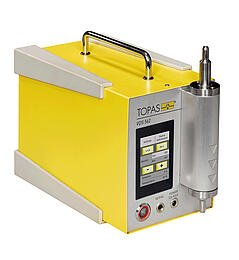
Characterisation of aerosols

Diverse technologies for different tasks
Aerosols are ubiquitous. Either they are produced involuntarily through natural and anthropogenic processes or are synthetised to serve specific tasks. The behaviour of aerosols depends on their state of dispersion, i.e., on the form (including particle size distribution, material, morphology, charge) and the spatial distribution (including concentration) of the particles. Knowledge of these properties is the basis for many fields of work (occupational safety and environmental protection, research and development, testing and calibration) in which aerosols are important. Therefore, there is a high demand in industry, service companies, and government or scientific institutions for aerosol technologies for sampling, sample conditioning, and sample analysis.
Sampling
The starting point for the quality and reproducibility of any aerosol analysis is sampling, which must also meet specific requirements depending on the task. These include, among others:
- isokinetic sampling by means of suitable sampling probes (e.g. SYS 528, SYS 529) to avoid over or under estimation, especially of particles greater than 1 µm
- aerosol sampling from pressurised pipes and containers (SYS 525)
- taking aerosol samples from different locations (e.g. with sampling switching units SYS 520, SYS 520/S, or SYS 521)
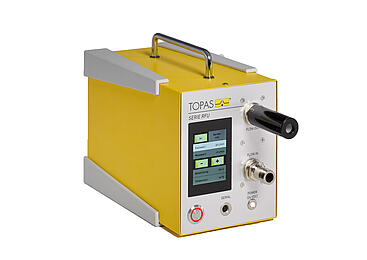
- realisation of defined sampling volume flows (RFU 564)
Measures of conditioning
To avoid measurement artefacts and to protect the measurement technology used, targeted and defined measures of conditioning are usually required on the aerosol sample after sampling and prior to the actual aerosol analyses:
- reduction of the particle concentration (dilution) to the aerosol-analytical optimum (DIL 5XY, DDS 560, VDS 562) depending on the respective measuring principle.
- modulation of the aerosol charge state, e.g. targeted unipolar charging or neutralisation (EAN 581)
- removal of volatile organic components (TDD 590)
- loss-optimised sampling lines, e.g. electrically conductive lines (antistatic hose)

FOR US, IT’S ALL ABOUT SIZE.
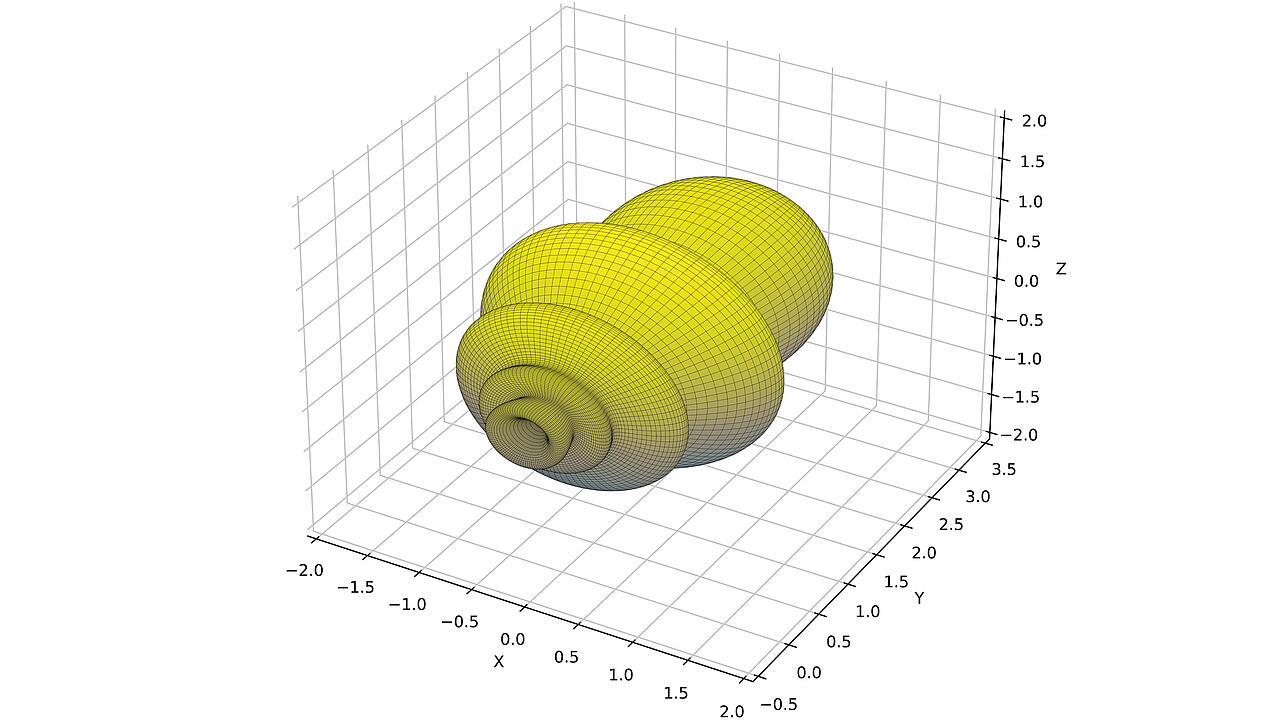
Sample analysis
Only after sampling and conditioning does the actual particle characterisation concerning size and/or concentration take place. Depending on the analytical task, either individual devices are used or several techniques based on different physical measurement principles are combined for different size ranges. Therefore, we also have different technologies in our portfolio:
- light scattering spectrometers (LAP 322, LAP 323) according to ISO 21501-1 for time-resolved analysis of particle size and concentration from 150 nm – 40 µm for highly-resolved characterisation of emissions, or for monitoring tasks
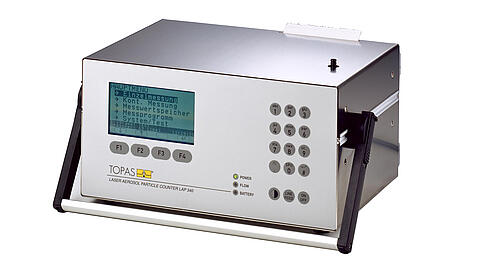
- optical particle counters (LAP 340, LAP 340/L) according to ISO 21501-4 for time-resolved determination of particle size distribution and concentration for cleanroom applications, i.e., for lowest concentrations
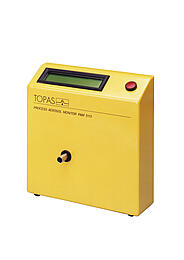
- process aerosol monitor (PAM 510) for monitoring particle concentrations and mean particle diameter
- aerosol photometers (PAP 610, PAP 612) for the characterization of particle mass concentration in higher concentrated aerosols
Our technical solution
DDS 560/C
Dynamisches Verdünnungssystem DDS 560/C zur variabel-einstellbaren Verdünnung von Aerosolen für variable Volumenströme
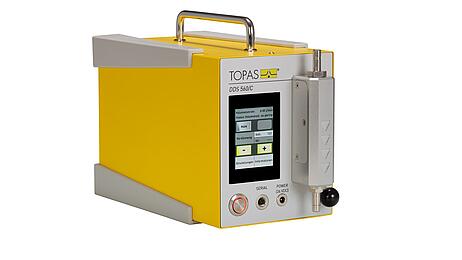
DDS 560
Dynamisches Verdünnungssystem DDS 560 zur variabel-einstellbaren Verdünnung von Aerosolen für variable Volumenströme
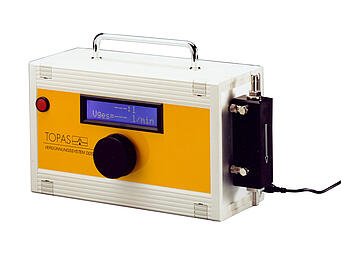
DIL 540/C
DIL 540/C Verdünnungssystem zur geregelten, statischen Verdünnung (1:100) von Aerosolen bei festem Volumenstrom (28,3 L/min), digitale Statusausgabe
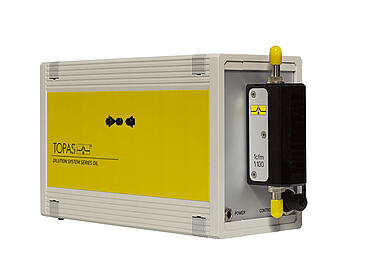
DIL 541/C
DIL 541/C Verdünnungssystem zur geregelten, statischen Verdünnung (1:10) von Aerosolen bei festem Volumenstrom (28,3 L/min), digitale Statusausgabe
DIL 545/C
DIL 545/C Verdünnungssystem zur geregelten, statischen Verdünnung (1:100) von Aerosolen bei festem Volumenstrom (3 L/min), digitale Statusausgabe
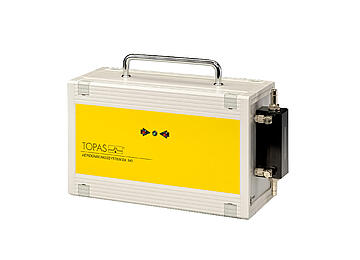
DIL 546/C
DIL 546/C Verdünnungssystem zur geregelten, statischen Verdünnung (1:10) von Aerosolen bei festem Volumenstrom (3 L/min), digitale Statusausgabe
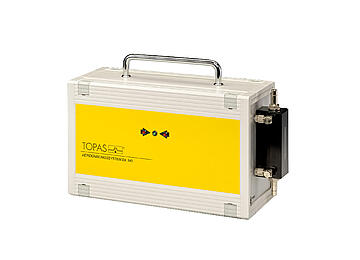
DIL 550
Verdünnungssystem DIL 550 zur statischen Verdünnung (1:100) von Aerosolen bei festem Volumenstrom (28,3 L/min)
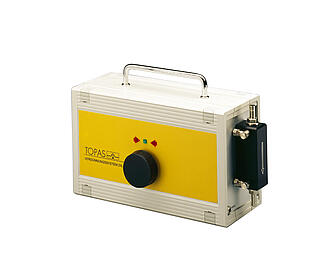
DIL 551
Verdünnungssystem DIL 551 zur statischen Verdünnung (1:10) von Aerosolen bei festem Volumenstrom (28,3 L/min)
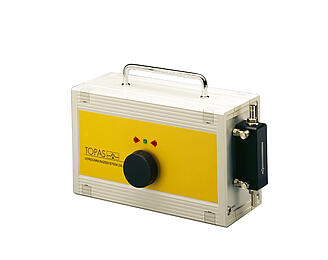
DIL 552
Verdünnungssystem DIL 552 zur statischen Verdünnung (kundenspezifisch) von Aerosolen bei festem Volumenstrom (28,3 L/min)
DIL 553
DIL 553 Verdünnungssystem zur statischen Verdünnung (1:100 or 1:10) von Aerosolen bei festem Volumenstrom (56,6 or 50 L/min)
DIL 555
DIL 555 Verdünnungssystem zur statischen Verdünnung (1:100) von Aerosolen bei festem Volumenstrom (2,83 L/min)
DIL 556
DIL 556 Verdünnungssystem zur statischen Verdünnung (1:10) von Aerosolen bei festem Volumenstrom (2,83 L/min)
DIL 557
DIL 550 Verdünnungssystem zur statischen Verdünnung (kundenspezifisch) von Aerosolen bei festem Volumenstrom (kundenspezifisch)
EAN 581
Elektrostatischer Aerosol Neutralisator EAN 581 zur Erzeugung positiver und/oder negativer Ionen für die Neutralisierung oder unipolaren Aufladung von Aerosolen
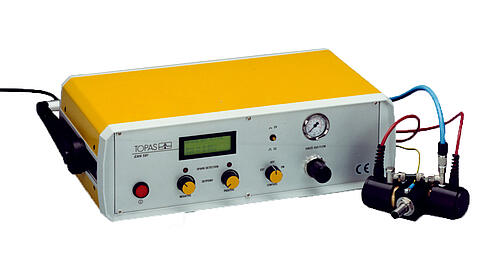
LAP 322
LAP 322 Aerosolspektrometer zur Analyse von Partikelgrößenverteilung und Partikelkozentration in Aerosolen, monochromes Licht
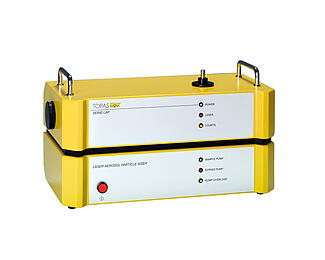
LAP 323
LAP 323 Aerosolspektrometer zur Analyse von Partikelgrößenverteilung und Partikelkonzentration in Aerosolen, Dual Wave Length Technology
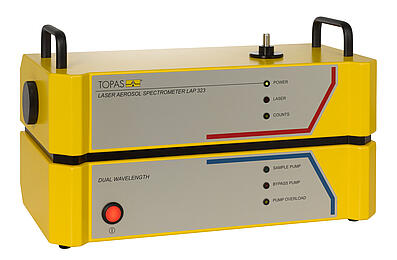
LAP 340/L
LAP 340/L Optischer Partikelzähler zur Analyse der Partikelgrößenverteilungen und Partikelkonzentrationen in Aerosolen, ideal für Filterprüfungen (2,83 L/min)
PAM 510
Prozess Aerosol Monitor PAM 510 zur Analyse der mittleren Partikelgröße und Partikelkonzentration in monodispersen Aerosolen
PASWin
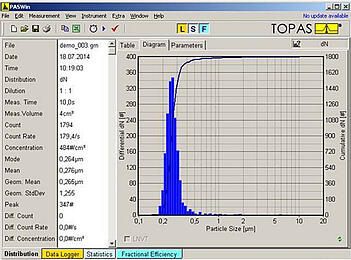
PASWin Software für die Konfiguration, Steuerung, Messwerterfassung und Datenanalyse von Partikelzählern und Aerosolspektrometern
RFU 564
Regulated Flow Unit RFU 564 zur Erzeugung variabel einstellbarer und geregelter Volumenströme bis 100 L/min für Saug- oder Druckbetrieb
SYS 520
Probenahmeumschalteinheit SYS 520 zur Entnahme von Aerosolproben aus zwei Probenahmeorten
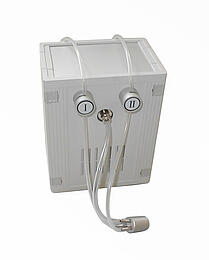
TDD 590
Thermodenuder TDD 590 zur Entfernung leichtflüchtiger organischer Komponenten (VOC) aus Aerosolen

VDS 562
Verdünnungssystem VDS 562 zur variabel einstellbaren, druckverlust-kompensierten Verdünnung von Aerosolen bei definierten Volumenströmen